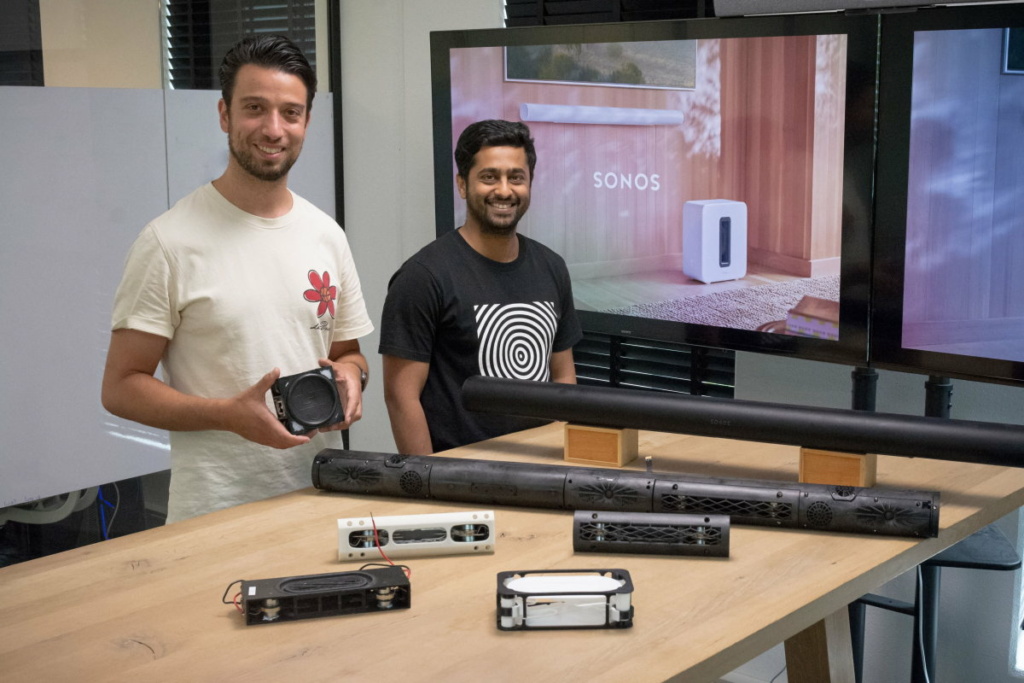
Sonos redesigned its speakers to fit in a slim soundbar without compromising audio quality. To achieve this, it merged its audio expertise with innovation from Mayht, a Dutch company acquired in 2022, and simulation software that significantly sped up the engineering process.
At the end of last year, Sonos introduced its new Arc Ultra soundbar, which contains fourteen speakers. This one soundbar produces the full Dolby Atmos experience. To make the speakers small enough to fit into the soundbar while maintaining high-quality audio, Sonos was supported by the experienced engineering team from Mayht, which it acquired in 2022, to shrink the technology.
To shrink speakers without shrinking sound, the technology not only saw the hardware being re-engineered but also the design workflow. The benefits of using simulation software with multiphysics capabilities significantly accelerated the design process, while reducing the number of prototypes necessary to optimize the design.
The testing of simulation software began via an external company in 2019. With that arrangement, the designers had to wait two weeks before their simulations could be run. They quickly realized the benefits of the simulation data, but the two-week wait was quite long. They started experimenting with open-source software specifically for magnetic simulations, which increased the output to 100 simulations per day.
As the team continued designing, moving into structural and design simulations, they looked for software that could support every part of their engineering process simultaneously. Comsol gave them this opportunity. “The output of their software proved that their simulations were very close to the output of the actual prototype,” says Naphur van Apeldoorn, lead mechanical engineer at Mayht at the time and now senior manager at Sonos. “This allowed us to further optimize a part before having to build a prototype, reducing costs and saving time.”
Because the simulations and prototype performed so similarly, Mayht could continue optimizing its product with simulations while building a prototype. This still had value, as it validated the data points the simulation gave and added corrections to the software to keep it on par. However, there was no longer any need to wait for the prototype to be built before continuing simulations.
3D-printed parts
Sound consists of pressure waves reaching our ears. A speaker produces those waves using a cone with an air-tight membrane that moves back and forth, pushing and pulling the air. To move enough air to create rich, deep sounds, traditional speakers rely on relatively large cones and enclosures. Shrinking the speaker often means sacrificing that air displacement, which results in loss of volume, bass or clarity. With Mayht’s knowledge on reducing speaker size, the Sonos team set out to design a soundbar with multiple speakers – bass woofers, mid woofers and tweeters – to create the full Dolby Atmos experience in one sleek device.
“Our first challenge was how to fit the tall and rectangular audio technology into the slim and elongated Sonos soundbar, which was due for an update,” explains Sanjit Shankar, senior simulation engineer at Sonos. “We made over 900 CAD designs of the speaker, over half of which we put in a simulation. We then 3D-printed about thirty of those designs for testing in the first month.”
The team had positive experiences using 3D-printed parts for testing. “While these weren’t as durable as the final production components,” Van Apeldoorn notes, “they lasted just long enough for us to do initial testing. When combined with the components that couldn’t be 3D-printed, such as the magnet and coils, their performance was close enough to provide meaningful results on, for example, motor stability and output.” As printing parts is much faster than traditional manufacturing methods, it allowed the team to quickly validate design choices and simulation data, speeding up the testing process.
Assembly level
A speaker contains a voice coil, which is a small electromagnet that’s attached to the cone and that makes it move to create pressure waves perceived by the ear as sound. For the cone to vibrate accurately, it must be held securely in place. The suspension system used for this is a combination of a flexible rubber surround and a springy component called the spider, a woven fabric disc that keeps the voice coil centered while allowing it to move back and forth smoothly.
All these different parts have a natural frequency of vibration. In a speaker, this vibration can cause distortion and other problems. “Take, for example, the spider in a speaker,” Shankar explains. “If that spider starts vibrating, the cone stops moving and no sound is produced. Fitting the speaker into a much smaller soundbar while maintaining the quality of the output meant that we had to redesign the spider significantly.”
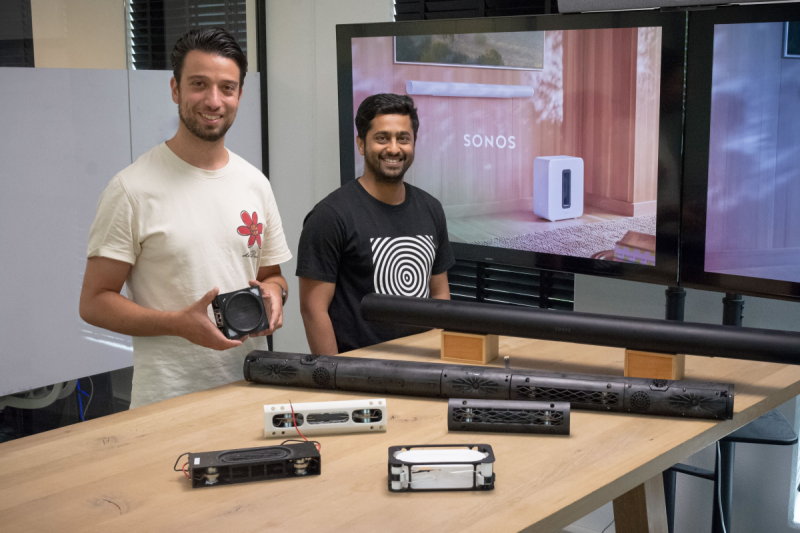
The newly designed spider had to be rigid enough not to distort the sound, durable enough to withstand the stress of a cone vibrating over 100 times per second and light enough to withstand fatigue tests. The team ran hundreds of CAD designs through the simulation software and 3D-printed several of them. In the end, they came up with an entirely new spider design that worked for the much smaller space.
This design was only one part that was adapted for this project. The new transducer in the soundbar works with two cones instead of one, which improves air displacement to produce high-quality sound. Four motors are placed off to the side to allow a thinner design, each motor suspended by a spider and connected to another motor via a bridge. The motors were optimized using 3D magnetic simulations and the bridge underwent topology optimization to reduce mass.
Another important aspect of speaker technology is the choice of materials. “Switching materials was quite easy in the Comsol software,” Van Apeldoorn says. “We could run simulations of the same design with different materials like carbon and aluminum to see which would work best. The software is user-friendly and, again, the simulation output proved to be very similar to the prototype output when we tested the different materials.”
The Arc Ultra consists of multiple speakers, each with many moving components. To speed up the design, Sonos had different teams working in parallel on different parts of the speakers and the final soundbar. At first, these teams mostly worked separately, optimizing their part of the design, but at some point, everything had to be assembled. Comsol’s simulation software was capable of supporting this process as well, allowing for optimization on assembly level.
AI
Designing this speaker without simulation software would have been virtually impossible, according to Van Apeldoorn. “Not only did the simulations help us reach the optimal designs for the separate parts and the assembly, because we could prove that the simulations were on par with the output from the actual prototypes, our team leaders were also much more easily convinced to let us test less conventional designs and materials once the simulations demonstrated feasibility.”
For example, simulated stress tests helped the designers create reliable new spider designs, instead of waiting for the outcome of long-term durability tests. This valuable data let them adapt the design much more efficiently than they could have done using only prototypes. Shankar: “Simulations change the design process from guessing what to do to knowing what to do.”
Shankar sees a clear role for AI in the future here. “With computational power becoming cheaper and AI being more and more capable of making smart decisions, it may become possible to run your design suggestions through an AI model and get the answer that way.” It’s also feasible that in the future, AI can automate the process of tweaking the design toward the optimal outcome, rather than designers making every single change in their CAD software by hand.
Lastly, Van Apeldoorn adds, “Right now, we often optimize one part before running assembly simulations, because assembly simulations take longer to run. AI, however, can make very fast and sophisticated estimates of how a hundred different parts will behave. This is already available in Comsol surrogate models and we’re testing what this will mean for us at Sonos. It won’t replace the need for simulations, but once the model is trained with enough data, it will make the overall process much faster.”
This article was written in close collaboration with Comsol.